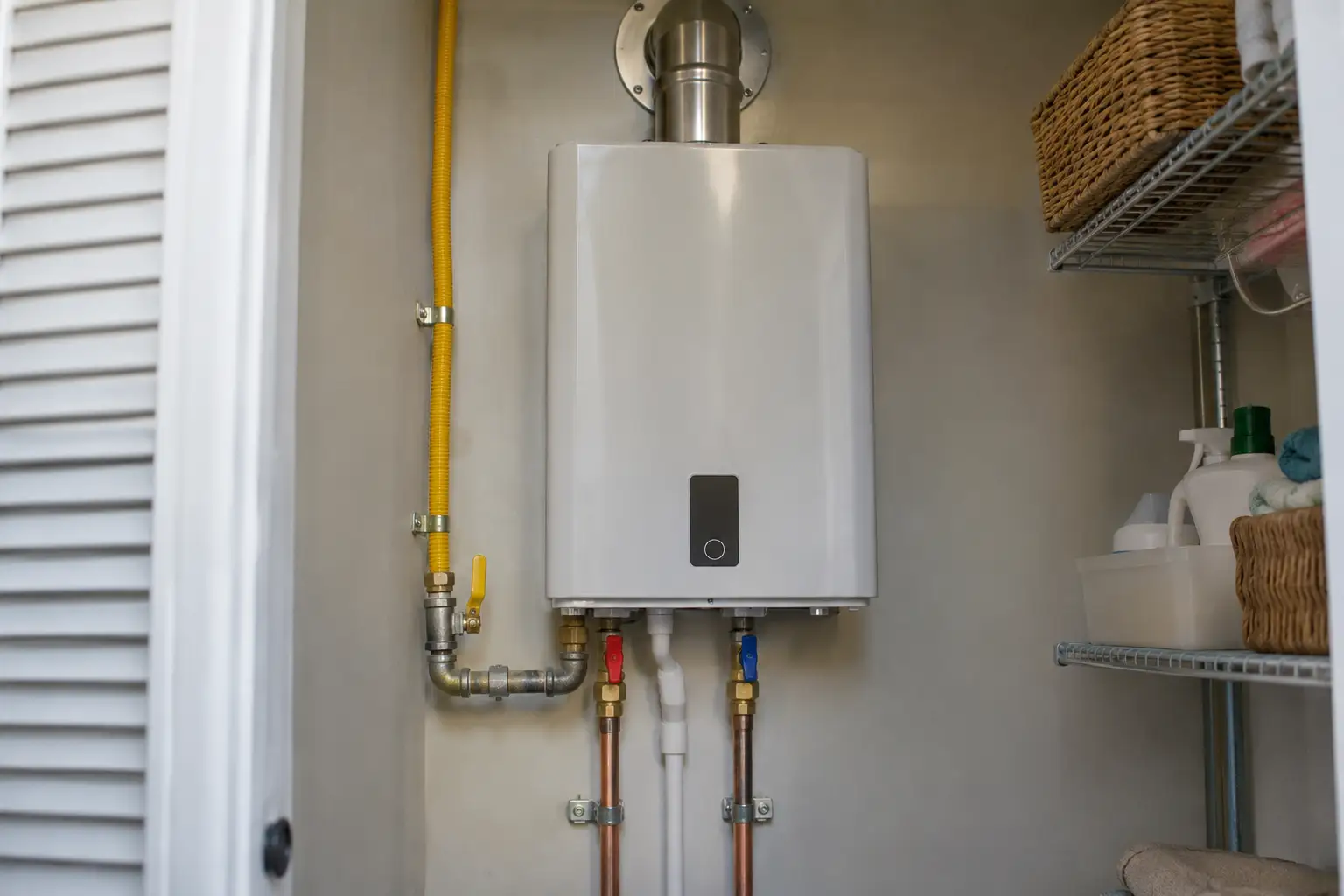
A tankless heater that stops firing usually tells you why, in the form of a code on its display. Write that code down, because it is the best clue the technician will have. Call us for tankless water heater repair in Cheyenne and a local technician can come out to read the unit, test the parts behind the code and get hot water flowing again.
First checks for a tankless unit with no hot water
Tankless heaters heat water only while it flows, so a problem shows up the moment you open a tap. These checks take a couple of minutes.
Read the display
Write down the code exactly as shown, plus the brand and model from the label. Resetting the unit over and over can clear the code without fixing anything.
Confirm gas and power
See if the stove or furnace still runs on gas. Check that the unit has power, since tankless heaters need electricity for the fan and controls even when they burn gas.
Open one hot tap all the way
The heater only fires above a minimum flow. A trickle from a single sink may not be enough to start it.
Call Plumber Cheyenne
Give us the code, the brand and what you were doing when it stopped. A local technician can come out to trace the fault.
Gas smell or a scorched vent
If you smell gas, leave the house now without switching anything on or off, and call 911 or the gas company emergency number from outside. If the vent pipe looks melted or scorched, turn off the unit and its gas valve and keep the area clear.
What tankless water heater repair covers
A tankless unit packs a lot into a small box. Tankless water heater repair means finding which of these parts is behind the fault rather than replacing the whole heater.
Error codes in plain terms
Each brand numbers its codes differently, so the manual or the label inside the cover is the real reference. Most codes, though, fall into a few families.
| The code points to | What it usually means | What the technician checks |
|---|---|---|
| Ignition failure | The burner tried to light and did not. | Gas supply, igniter, flame rod and the gas valve. |
| Flame lost while running | The flame went out during use. | Gas line size and pressure, vent blockage, a dirty flame rod. |
| Overheating | The heat exchanger got too hot. | Scale inside the exchanger and the water flow through it. |
| Exhaust or fan fault | The fan cannot move enough air or the vent is blocked. | Vent terminations, the fan and the pressure switch. |
| Low flow or flow sensor | The unit does not see enough water moving. | The inlet filter screen, the flow sensor and the fixtures. |
| Scale or service reminder | The unit has detected scale or reached its service interval. | A descaling flush and the inlet filter. |
A code that comes back right after a reset is the unit asking for help. Keep a list of every code you see and when, because a pattern makes the fault far easier to pin down.
Scale and the descaling flush
Minerals in the water stick to the hot surfaces of the heat exchanger. As the layer thickens, the unit runs hotter, heats more slowly and starts throwing overheating or scale codes.
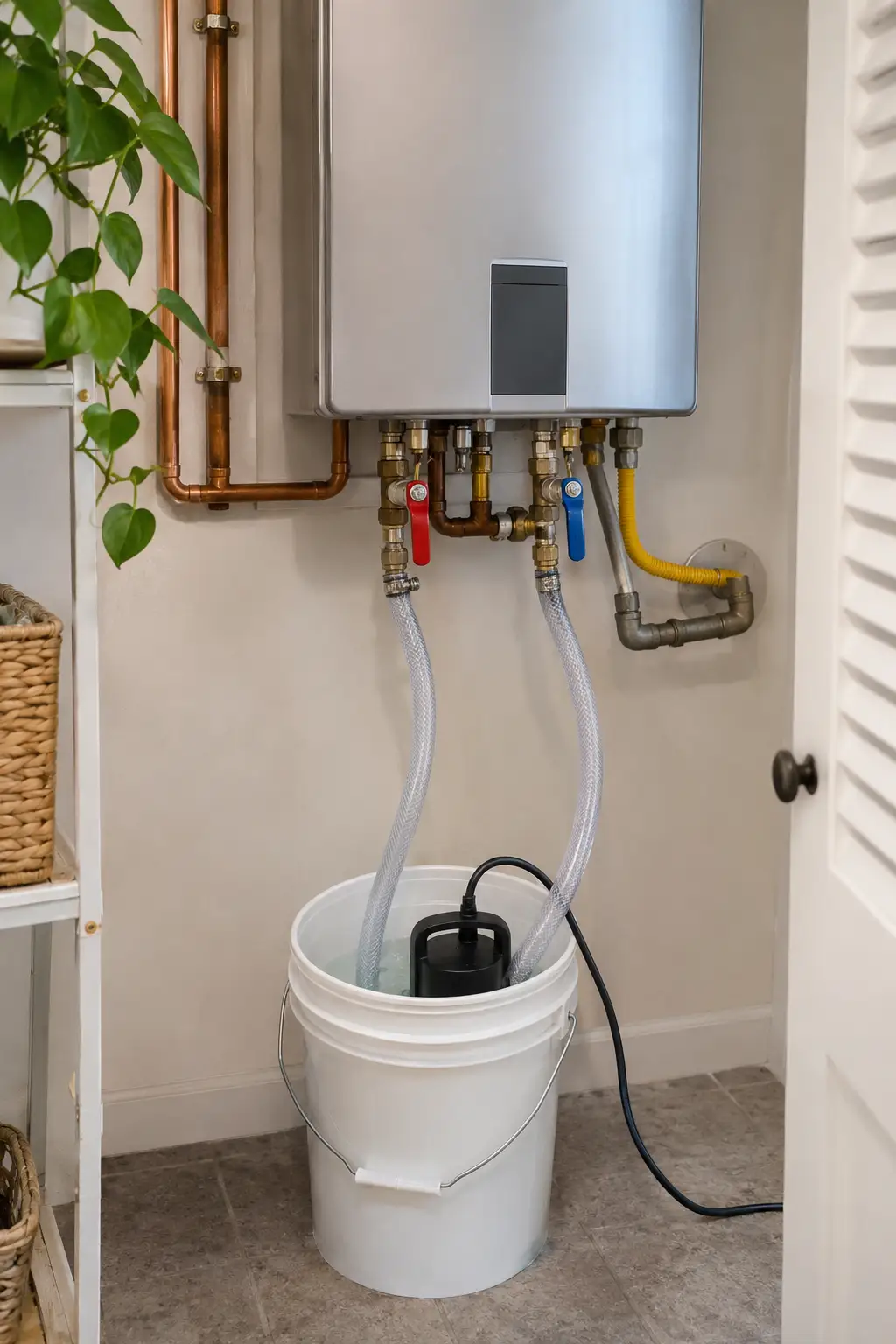
A descaling flush cleans it out. The water is shut off at the service valves, a small pump circulates a descaling solution from a bucket through the exchanger, and fresh water rinses it clean. The inlet filter screen gets cleaned at the same time.
How often a unit needs this depends on the water and how hard the heater works. The technician can look at the exchanger and the filter and suggest an interval for your home.
Signs the tankless heater needs service
Act right away
- Gas smell near the unit. Leave the house and call from outside.
- Water leaking from inside the cabinet. Close the service valves and switch the unit off.
Get it seen today
- No hot water and a code on the display. Write the code down and call.
- Hot water cuts out when a second tap opens. Gas supply or flow is falling short.
Can wait a few days
- Temperature that swings up and down. Scale or a sensor is starting to drift.
- A scale or service reminder code. Book a descaling flush.
Venting, gas supply and flow rate
Venting
Tankless units push their exhaust out with a fan, and many also draw outside air through a second pipe. Drifting snow, ice, a bird nest or a crushed pipe at the wall can block either one, and the unit shuts down to protect itself. Condensing models also make acidic water that drains through a small line, and that line can freeze or clog in a Cheyenne winter.
Gas supply sizing
At full fire a tankless burner draws far more gas than a tank heater. When a tank is swapped for a tankless unit on the old gas pipe, the line or meter may be too small. The heater works with one tap open and loses its flame when the shower and the dishwasher run together. The fix is a larger gas line, which a gas line job can handle.
Flow rate
Every unit can heat only so many gallons a minute by a given amount. On the coldest days the incoming water is colder, so the same unit delivers less hot water. Too many fixtures at once leaves everyone lukewarm, while a very low flow from a single tap may not start the burner at all.
The cold water sandwich
If you shut the shower off for a moment and turn it back on, the hot water left in the pipe arrives first, then a slug of cold while the burner relights, then hot again. It is normal for most tankless units. A recirculation setup can reduce it, and the technician can tell you whether it suits your plumbing.
Emergency or can it wait?
Call now
- A gas smell anywhere near the unit or the gas line
- Water spraying or leaking from inside the cabinet
- A melted, scorched or disconnected vent pipe
- A unit on an outside wall that froze and is now dripping
Can usually be scheduled
- A scale or maintenance reminder code
- Water that is warm but not as hot as before
- The cold water sandwich between uses
- Hot water that runs short only with several taps open
What the visit looks like
- Read the unit. The technician pulls up the code history and checks gas pressure, power and the venting.
- Test the suspect parts. The igniter, flame rod, flow sensor and inlet filter are checked against what the code points to.
- Explain the options. You hear what failed and what fixing it involves. Any work waits until you decide.
- Fix and flush. The failed part is replaced, and the exchanger is descaled if scale played a part.
- Run it hard. Several taps are opened at once to confirm the unit fires, holds its flame and keeps the temperature steady.
If the unit is near the end of its life, or a new one would mean a larger gas line, the technician can lay out that path too, including going back to a tank and water heater installation.
Questions and upkeep for a tankless unit
- What does this code mean on my model, and what caused it?
- Is my gas line large enough for this heater at full fire?
- How much scale is in the exchanger, and how often should it be flushed?
- Are the vent and air intake clear and protected from drifting snow?
- Is the condensate line protected from freezing?
Between visits, clean the inlet filter screen when the unit asks for it, keep snow cleared from the vent terminals after a storm, and note any new codes with the date. If the heater ever leaks or the gas smell shows up, the emergency checklist walks you through the first steps.
Questions people in Cheyenne ask
Why does my tankless water heater show an error code?
The code is the unit telling you which safety check failed, such as ignition, flame, overheating, venting or flow. The numbers differ by brand, so write down the exact code and model. It points the technician to the right part to test first.
Why does my tankless heater go cold when two showers run?
Either the unit has hit the most hot water it can make at that incoming water temperature, or the gas line cannot feed the burner at full fire. The first is a sizing limit, while the second is often fixed with a larger gas line.
How often should a tankless water heater be descaled?
It depends on the minerals in your water and how much hot water the household uses. Many owners do it about once a year. The technician can look at the heat exchanger and inlet filter and suggest a schedule that fits your home.
Can I reset my tankless water heater myself?
Turning it off and on is fine once to see if the code clears. If the same code returns, stop resetting it, because repeated restarts can hide a real fault such as a vent blockage or a gas supply problem.
What is the cold water sandwich?
It is a short burst of cold water between two hot ones, felt when a tap is turned off and back on quickly. The water left in the pipe is hot, then cold water flows while the burner relights. A recirculation setup can reduce it.
Can a tankless heater freeze in winter?
Yes, especially units on outside walls or with long vent runs. Most have built in freeze protection that needs power and gas to work. A long outage in a hard cold snap can leave the exchanger or condensate line frozen, so call before running it if it drips.
Tankless repair across Cheyenne
We take tankless calls from every part of Cheyenne, for units in closets, garages and on outside walls. Have the brand, model and any code ready when you call.
ZIP codes 82001, 82007, 82009